Tuesday, March 1, 2011

Law and Politics - Some observations in cantonment house case


Judgment Review
Law and Politics
Some observations in cantonment house case

M. Jashim Ali Chowdhury
Published in the Daily Star, Law and Our Rights, February 26, 2011. 
Available: http://www.thedailystar.net/law/2011/02/04/index.htm 

The recently evacuated cantonment residence of the Honourable Leader of the Opposition was for long at the centre of political controversy. This was the house in which late President Ziaur Rahman entered in 1972 as the Deputy Chief of Army Staff. He became the Chief of Army Staff after August 1975 and later on the President of the country in 1976. Whatever post he held, Zia and his family never left the house. After the death of Zia in 1981, the present Leader of the Opposition being his wife became the recipient of his life long pension. Besides that, the Council of Ministers in its meeting held on 12.6.1981 took a decision to provide her huge financial and other benefits including a house with all modern amenities in Gulshan. Neither in that nor in any other meeting of the Council of Ministers did the Government take any decision to demise the cantonment house to Begum Zia.


It is alleged that the then (1991) Premier Begum Zia made the Cantonment, otherwise a depoliticized zone harbouring an apolitical military force, the focal point of all political influences. Coming to power in 1996 the AL government served Begum Zia a notice to leave the house which was not paid heed to. In 2009 a new notice was served to that purpose. Subsequently another notice asking her to show cause as to why she should not be directed to return the property in question within 15 days was served. The third and final notice asked her to hand over the possession of the house by another one month. This time Begum Zia challenged the notices before the High Court Division (W/P No. 2910/2009). After three successive motions of no-confidence over three different Benches, she placed her trust on the Bench comprising Nazmun Ara Sultana J. and Sheikh Hasan Arif JJ. This write-up intends to throw some ethics based academic lights on the legal points raised and answered therein. Specific references of the 40-page judgment available in the Supreme Court website are indicated within brackets.
The Cantonment House: Class A-1 or B-4?: The million dollar question that would determine the fate of the Writ was about the Class in which the cantonment house belonged. A Class A-1 land is not readily transferable while others may be. Rule 5 of the Cantonment Land Administration Rules, 1937 (CLA Rules, 1937) defines Class A-1 lands as the lands 'actually used or occupied by the Military Authorities, for the purposes of fortifications, barracks, stores, arsenals, aerodromes, bungalows for military officers.' The Leader of the Opposition's house, an official bungalow of a high ranking military officer, was definitely under Class-A1 category. Begum Zia's pleaders, however, raised at least three curious issues.
Who was in 'active occupation'?: Br. Huq once again put a technical jargon relying on Rule 4 of the CLA Rules, 1937. It requires a Class-A land to be in 'active occupation of the army'. But at the time of the lease the house was occupied by Begum Zia and her sons who were unquestionably the civilians! Therefore there is no scope to say that the said land was in 'active occupation of the army', Br. Huq amazingly brought something out of nothing (p 12). The Court however remained passive and found it 'not acceptable at all' that since some civilians continued living there, a bungalow no more remained in the active occupation of the army (p 20).
A wrong entry in Register: Relying on an entry in General Land Register prepared by the Military Estate Officer (MEO), Mr. Khan forcefully argued that the land was actually a Class B-4 land (p 11). The Attorney General offered the 'most probable' explanation as to the mistaken entry in General Land Register. Though the Court accepted the explanation, it based its decision on another point - a mere entry in the General Land Register would not change the actual class of a land which it acquired by virtue of statutory rules, i.e., Rule 5 of CLA Rules, 1937 (p 19).
Building arguments for a 'Building Site': The fogginess of Classification being almost removed, the petitioner traveled another way. Now her advocate argues that the house in question is 'Building Site' as per Rule 2(c) of the CLA Rules, 1937. The majeja of a 'building site' is that as per Rule 26 of CLA Rules 1937 it can be leased out for any period with the sanction of the government! The court however put the question in the alternative, 'Can it be argued that any building site cannot be treated as Class A-1 land?' So there is no escaping from the Class A-1 insignia (p 24).
Transferring a Class A-1 land: The land being undoubtedly in Class A-1 category, it could not be used or occupied for any purpose other than those specified in Rule 5 of CLA Rules. Given the situation, Advocate TH Khan now relies on Rule 16 and 26 of 1937 Rules which conditionally allow lease of any land irrespective of its class to any private individual (p 11). The Court in its turn relies on Rule 14 which permits use or occupation of a Class A-1 land with previous sanction of the government. The sanction being only for 'use or occupation', Mr. Khan's argument could not save the transfer of 165 Khata cantonment house for Tk.1/ (p 22). Taking the chance of a linguistic vacuum in Rule 26, Br. Huq argued that it never required a 'public interest' purpose for the lease. Begum Zia's case being very 'exceptional', the requirement was duly satisfied (p 27)! The Court pin pointed the Supplemental Notes to Rule 26 where the 'exceptional reason' is explained as 'reason of a public nature' (p 26). And Begum Zia's lease, a gesture of goodwill, involved no reason at all of a public nature (p 28).
A Presidential Supremacy Approach: To defend the 1981 bounty to Begum Zia her Advocates didn't left any avenue of arguments unexplored. Mr. TH Khan was of the view that the laws and rules regulating the administration of Cantonment properties did not take away the 'sovereign authority' of the government to execute such a lease (p 10). For this purpose, Barrister Moudud Ahmed found the classification of the land immaterial (p 14). Naturally the Court would not accept such an 'absolute or open-ended discretion' in the Government, a trustee of the people, to dispose of public property to whomsoever, at any price and in any manner he likes (p 33). As to the involvement of the Army Chief, Mr. Khan declared a sort of independence for the Army. He argued that the proposal being initiated from the Ministry of Defense, the President need not consult the Council of Ministers (p 11)! For obvious reasons, the Court could not consume such an Austinian assertion that the Chief of Army Staff could demise any government property defying even a democratically elected government (p 30).
The 'Political' Science of Law: The lease deed being void ab initio failed to create any tenancy at all. Yet the Court allowed the Leader of the Opposition at least 30 days to vacate the house (p 40). Counting the time from the final notice of 24.5.2009, the Leader of the Opposition got almost a one and half year to evacuate a house she was gifted unlawfully. Unfortunately the court sanctioned deadline was not cared for. A Leave to Appeal was made but consciously no stay on the High Court Division's order was sought. The field was created for a political victory from a clearly lost legal battle. Instead of arguing on the Leave Petition, a no-confidence on the Appellate Division itself was ready to be placed! Passing the deadline, Begum Zia was 'evicted' by the government and the 'tears of an ex-Prime Minister' over-shadowed a sheer illegality behind an unethical bounty. The 'bereaved nation' observed a day-long hartal in protest of political oppression! Now we realize why our teachers tell us in classes, “There is politics in law.”

The writer is a Lecturer, Department of Law, University of Chittagong.

Saturday, January 29, 2011

The Private University Act, 2010; Would the barking dog bite?

Law Analysis
The Private University Act, 2010; Would the barking dog bite?
M. Jashim Ali Chowdhury
Published in the Daily Star, Law and Our Rights, January 15, 2011

Link: http://www.thedailystar.net/law/2011/01/03/index.htm


The footstep, foothold and stronghold of the Private Universities in the filed of higher education is now a fait accompli. Today it requires no recognition but a critical appraisal. Well, then how to see it? A glass half empty? Or a glass half full? Some may prefer the first, while others may choose the last. But I (with my recent past three and half years' fellowship with private universities) would prefer a more specific answer it is one-third full leaving another two-thirds empty! 

The glass is 1/3 full because these (around 60) Universities are imparting:
-higher education to the students (around 95% of total students passing HSC) who would otherwise remain unattended by the public education machinery;
-politics and session jam free education; and
-responsible academic behaviour on the part of the faculty members ensured through the prism of continuous evaluation.

The glass is 2/3 empty because:
-bulk of the universities (except a few) are still lagging behind in quality education;
-there is a substantial accusation that some of these universities are still 'selling' certificates;
-the so called Evening Programs are the most attractive profit zones harboring the grossest irregularities;
-infrastructural and logistic arrangements are simply pathetic (except in some 'rich' universities);
-in terms of quality, fairness and accountability, the 'branch campuses' pose a nightmare;
-'research' as a component of University education is, subject to a few exceptions, almost unknown;
-most unfortunately, the spontaneous interference on the part of the sponsors ('owners' they are commonly called) in the administrative and academic affairs strikes at the root of the very concept of a 'University'. Sometimes a private university sponsored by a status hungry business tycoon resembles one of his many other private limited companies or at best a rural private college established in memoriam of the wife of a petty millionaire!
Given the circumstances, avoiding direct stance against the concept of Private University as a whole, some prescribe care coupled with a gentle admonition. The parliament has passed the Private University Act, 2010 which is professed to medicate some of the diseases beyond treatment of the repealed Private University Act, 1992 and Private University Ordinance 2008.
Establishing a Private University: A Private University may be established with a provisional certificate for initial seven years (Section 7(2)). This may be extended for another 5 years (Section 11(2)). Failure to apply for extension of provisional permission within first seven years or for permanent permission within maximum 12 years may result in the closure of admission (Section 12(1)). Most of the Private Universities are now running with provisional permission and have even failed to apply for permanent certification.
Regarding the permanent campus: For a permanent certificate a Private University needs, among others, a permanent campus established on at least 1 Acre landed property in any Metropolitan area or 2 acres landed property in other areas (Section 9(1)). This means that a Private University must find out its permanent campus within maximum 12 years of its commencement. Most of the private universities are unacceptably legging behind in this regard.
On the 'branch campuses': Sections 3(3) and 13(2) of the Act prohibit establishment of Branch Campuses, though there may be several sister universities with a common name (Proviso to Section 5). In that case the Private Universities willing to maintain their already established branches may opt for the establishment of independent administrations comprising separate Vice Chancellors, Syndicate, Senate and Academic Council, etc.
Locating the campuses: The campuses beneath or above commercial complexes, garment factories or even grocery shops mark our intellectual insolvency. Apart from the branch campuses, there is a tendency to establish as many campuses as possible in the same city, which are not less deficient than the branch campuses in terms of quality assurance. To check this unhealthy tendency, section 13 of the Act provides that seats of the campuses must be specified in the provisional or permanent certificate. Section 3(4) of the Act prohibits establishment of university campuses in certain places to be specified by the government.
Making Private University affordable: The competitively sky rocking tuition fees of the private universities has put them high above the reach of students with modest and middle class background. Section 42 takes care of this by requiring the tuition fee structure to be in consonance with the 'socio-economic standard' of the country. The University Grants Commission (UGC) is given a consultative status in this regard. However, the 'socio-economic standard' being a relative and vague term, poses no immediate 'threat' to the current trend. Again, Section 9(4) requires reservation of at least 6% seats for freedom fighter's wards and poor students coming from rural areas. These students would enjoy full tuition fee and other fees waiver.
Overseeing the academic affairs: Section 13(3) of the Act requires permission of the UGC to establish a Department or Faculty in a particular campus. Section 24 requires department-wise Syllabus Committee comprising external experts. Though these provisions form part of the day to day administration of UGC, there are substantial allegation of corruption and bribery within the UGC itself, in approving courses, syllabus and other academic curricula.
On the part timers: An unhappy feature that puts a private university under serious challenge is the running of the courses by part-time teachers basically drawn from the public universities. The 2010 Act has paid due attention to the part timers. Section 35(3) has put a ceiling on the part-timers which should not cross 1/3 of the total numbers of permanent faculties. Section 35(4) requires a 'No Objection Certificate' to be submitted by a part time faculty from his original workplace. Some Public Universities themselves have a rule requiring their faculties to take prior permission for any part time engagement and submit more or less 10 per centum of their income there from. However, public university authorities have been generous enough to apply the rule in flexible manner. Now it remains to be seen how section 35(4) of the Private University Act improves the situation and ensures the accountability of the honourable teachers.
Again, the 'Resource Persons' from non teaching professions are not included in the 1/3 limit. Exactly what does the term 'resource persons' means is not clarified in the Act. If they mean experts from the practical field occasionally coming to the classes to give a touch of reality in the world of books, this is no doubt a progressive provision. But we know the reality. We know a lot of Civil Servants and Judicial Officers 'serving' as part time faculties and conducting full-swing courses in different private universities. Critiques often say these 'resource persons' serve dual purposes help maintain a good 'link' with the power base of the state and come to 'aid' in times of administrative or legal difficulties faced by the university concerned. With the 'part time' faculties, 'resource persons', 'advisers' and 'coordinators' you can manage things for the time being. But this is never going to give the private universities an institutional shape, though the sponsors like to point at Oxford and Cambridge as the best examples of private universities leading from the front.
Job security etc: Most of the private universities deliberately lack any Service Rules so that the teachers and employees may be treated in whatever manner they like. Job security, academic freedom and non-intervening working conditions are a far cry there. It is quite humiliating that in some universities the administrative officers 'police' the teachers! I know even of an Honourable Vice Chancellor who was 'instructed' over phone not to come to office the next day! This is why the young and promising teachers of the time are not ready to take 'private university teaching' as a profession. This is still too dangerous a risk to take. All coming here come as transit birds to stay in the platform to catch the train. Sections 16 and 43 of the Act require the copies of service rules, rules regarding the creation of posts, appointments and pay scale to be submitted to the UGC. In absence of adamant political commitment these provisions would ensure nothing more than a mere formality.
The Accreditation Council: The greyest area in the Act is the proposed Accreditation Council. Given the huge workload of the UGC and its infrastructural insufficiency to oversee the activities of the private universities, an Accreditation Council seems befitting. As per Section 38, the Accreditation Council would be established by the Government and its functions and powers shall also be determined by the Government by Rules. It will be interesting to see how the Government exercises its rule making power to establish a tiger having claws and teeth.
Doubted aspirations!
The Private University Act 2010 wants to see 'non profitable' private universities (Sections 44 and 45) devoted strictly to the cause of education and research which is a lofty dream indeed. Private Universities are the realities of an era of deregulation where education is not a mere virtue rather an essential commodity. Naturally the profit seekers will explore opportunities in a 'business' that earns wealth as well as status and their political power bases are not too weak. Now let's see, how aspirations of education flourish!
The writer is Lecturer, Department of Law, Chittagong University.

Friday, January 7, 2011

A compilation taking us back to the original spirit

Law Book Review

M. Jashim Ali Chowdhury
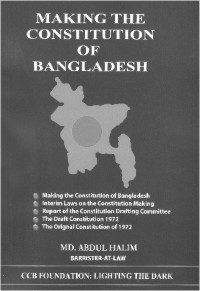
Making the Constitution of Bangladesh Barrister Md. Abdul Halim Publisher: CCB Foundation, Dhaka Price Shown: Tk. 250/-

Barrister Halim is a popular writer of law books with around 30 publications to his credit. As an author he came to light through his first scholarly endeavor Constitution, Constitutional Law and Politics: Bangladesh Perspective which enjoyed a sort of monopoly in the study of Constitutional Law of Bangladesh over the last decade. Since then he is writing relentlessly on various issues. The present one under review, Making the Constitution of Bangladesh, is the latest of his efforts.
Divided into five chapters, Chapter 1 (pp 9-38) of the compilation contains a short commentary on the history of constitution making which is an abridged reproduction of some of his thoughts we already read in Constitution, Constitutional Law and Politics: Bangladesh Perspective. The extracts from Abul Fazl Huq's Constitution Making in Bangladesh published in the Pacific Affaires Journal (Vol 46, No 1, Spring, 1973) of University of British Columbia, available in JSTOR's online catalogue will throw light on the constitution making from an altogether different point of view. A short note on the Declaration of Independence (p. 11) reflects his own assessment of the issue.
Chapter 2 (pp 39-58) reproduces some pre-constitutional instruments like the Proclamation of Independence, Laws Continuance Enforcement Order, the Provisional Constitution of 1972 etc. Chapter 3 (pp 59-86) accommodates the report of the Constitution Drafting Committee to the Constituent Assembly. This document has special significance to the new generation readers of the constitutional history. Chapter 4 (pp 87-200) reprints the Draft Constitution proposed by the drafting committee to the Assembly and lastly Chapter 5 (pp 201-304) reprints the original constitution of 1972.
I may not agree with some of the 'weaknesses and drawbacks' in the constitution making that the author finds, yet I acknowledge the greater purpose the compilation would serve specially to the post-liberation generation in taking them back to the root of the original spirit enlightening our nationhood. This handy compilation would serve the purpose of researchers working on our constitutional history.

The reviewer is Lecturer, Department of Law, University of Chittagong.

Friday, November 12, 2010

Reminiscence of a lost battle: Arguing for the revival of second schedule

Law alter views
Reminiscence of a lost battle: Arguing for the revival of second schedule
M. Jashim Ali Chowdhury

Published in the Daily Star, November 6, 2010. 
https://web.archive.org/web/20121024220523/http://www.thedailystar.net/law/2010/11/01/index.htm


The original Constitution of 1972 with so many of its illuminating features is not excessively hailed as a document of hope. So many of its features had cures to so many of the hazards created by its post-martial-law version. Take for example the issue of a significant presence of Bangabhaban in national life. The majestic fashion in which the high stature and weight of a 'titular' Presidency was upheld in the original constitution, if kept alive could have served its institutionalisation immeasurably. In recent years, unfortunately the President, 'a symbol of national unity', is not less partisan then the Cabinet itself! But what did the original constitution contemplate?
Electing the President
The framers of the Constitution 'had the foresight to apprehend that this country might not always be served by wise, conscientious and true patriotic persons' (The Appellate Division in 5th Amendment Judgment, p 58). Perhaps as a pre-caution on their part, they prescribed a commendable method of electing the President. It was taken care of that no MP, while voting to elect the President, act as a mere party puppet supporting the party nomination. Article 48(1) of the original Constitution prescribed the procedure which was exhaustively elaborated in the Second Schedule. The Second Schedule introduced a Secret Ballot system of voting. No ballot or its counter foil could bear any mark or sign giving any clue regarding the identity of a particular MP voting. Even there was a provision in Paragraph (12a) of the Second Schedule for cancelling a ballot if there was any sign of identification of the voter. The MPs were to act as liberated agents voting for any candidate they like.
For obvious necessity of the new system, the Second Schedule was omitted by the 4th Amendment. Till then it was not revived, not even by the 12th Amendment reviving the Parliamentary Democracy. Rather the 12th Amendment caused the Article 48(1) provide: 'There shall be a President of Bangladesh who shall be elected by members of Parliament in accordance with law.' Instead of 2nd Schedule, now Parliament is to enact law regulating the Presidential election. Accordingly the President Election Act, 1991 was passed in the Parliament. The President Election Rules 1991 were made by the Election Commission in pursuance of the Act.
Section 10(3) of the 1991 Act provides that Election Commission should prepare ballot paper of the required number and each ballot paper should have two parts. In the counterfoil in each ballot paper the name of the elector (i.e, the MP voting for a candidate) should be written. An MP is required to sign his name both in the outer foil and counter foil making his choice vulnerable to exposure. Section 11 provides that the Chief Election Commissioner, as the Returning Officer, shall count the votes openly.
Why open ballot?
The ulterior motive behind the introduction of Open Ballot system was exposed when the BNP government nominated for the Presidency Mr. Md. Abdur Rahman Biswas, controversial for his Anti-Liberation War role during 1971. The ruling party ignored the repeated call from the main opposition Awami League (AL) to nominate a candidate acceptable to all. AL, though was sure of the defeat of its candidate, nominated Justice Badrul Haider Chowdhury, an ex Chief Justice of Bangladesh. In the meantime criticism and conscientious objection against the BNP nomination was raised across the country. Situation was such that even some pro-liberation war MPs of the ruling BNP were considering to vote against Mr. Abdur Rahman Biswas. On October 8, 1991 the election was held and the ruling party candidate escaped an almost defeat. Out of 330 votes, Mr. Biswas secured 172 (least votes needed were 166) and Justice BH Chowdhury got 92 votes. A total of 66 MPs refrained from voting.
Abdus Samad Azad v. Bangladesh: The forgotten battle
As a last resort after the election, six MPs of AL namely, Abdus Samad Azad, Suranjit Sen Gupta, Tofael Ahmed, Matia Chowdhury, Rahmat Ali, Md Nasim and Prof. Abdul Hafiz challenged the President's Election Act 1991. Br Moudud Ahmed, then a Jatya Party MP, also challenged the Act and the Rules [44 DLR 354]. As the writ petitions involved similar questions of laws, they were considered together before the Bench of F.H.M Habibur Rahman and Abdul Hasib JJ. While the Senior Judge of the Division Bench M Habibur Rahman J rejected the writs summarily, Abdul Hasib JJ issued a Rule Nishi (And later on, Justice Hasib was not confirmed as a permanent Judge of the High Court Division!). Ultimately the issue was thrown to the Single Bench of Anwarul Hoque Chowdhury J.
The Petitioners' Claim - The intention of the petitioners was not the revival of Second Schedule through judicial order. In fact the Court lacked such power. They were simply trying to argue that any law in this regard must provide a procedure more or less similar to the omitted Second Schedule. Even in the absence of Second Schedule, the over all scheme and spirit of the Constitution warranted a 'Secret Ballot' voting in Presidential Election. Barrister Amirul Islam appearing on behalf of the petitioners attacked the 'Open Ballot' from three sides:
First, Open Ballot system was repugnant to Article 39 of the Constitution guaranteeing unconditional and unrestricted freedom of thought and conscience. Since the 1991 Act put a bar on the independent and conscientious decision making by the MPs voting for the Presidential Candidates, now their fundamental right to choose the President freely was put at a stake.
Second, considering the Preamble and Articles 7 and 11 as a whole, the 1991 Act stroke at the 'Basic Structure' of the Constitution by converting the concept of 'Presidential Election' into a mere 'Selection' (Para 6).
Third, by the 1991 Act, the vice of Article 70 would be unnecessarily extended to the Presidential Election. MPs voting in Open Ballot would run the risk of losing his seat, had he voted against the candidate nominated by his party. The philosophy behind the inclusion of Article 70 was to prevent malicious defection and unnecessary defeat of the Cabinet in the floor. Therefore its effect should be limited only to the essential legislative affairs. The intention of the framers of the Constitution not to allow Article 70 operate in Presidential Election was evident in the Second Schedule (Para 26).
The Attorney General's defence - The then Attorney General Barrister Aminul Huq was very much literal and subjective in his arguments:
First, to the Attorney General, the right to vote was not a fundamental right. Being a creation of statute it could be regulated or even taken away by another statute. To him, choosing the method of voting was a matter of political convenience and necessity of particular occasion and no one could claim a fundamental right to vote in a particular method.
Secondly, voting by Open Ballot was not totally unknown to the Constitution, specially when election of the Leaders of the House and Opposition, Speaker, Deputy Speaker etc were held through Open Ballot (Para 7). Here the Attorney General cautiously evaded a vital difference between these offices and the Presidency. That the level of 'neutrality' expected from the President was much higher than the expectation from these offices was totally bypassed.
Thirdly, regarding the operation of Article 70, the Attorney General straightly argued that political parties should get priority in all public affairs. MPs were bound by the party mandate and directions. People elected them on the basis of party and so they had a right to know for whom their representatives were voting!
The Court's response - The Court upheld the arguments of the Attorney General in its totality (Para 18, 20 and 22):
First, it offered a new dimension to the concept of 'Freedom of Thought and Conscience.' The gist of the concept may be summed up as follows: Unrestricted freedom of thought and conscience relates to the 'Private Liberty' of citizens. Private Liberty is an opportunity to express freedom of choice in those areas of rights where the result of its effort mainly affects that individual and none else. An MP while voting in Presidential election doesn't exercise Private Liberty rather he performs a public duty. In exercising public duty no unrestricted thought and conscience is available (Para 25).
Secondly, the Court was sharp in rejecting the basic structure approach. Neither the right to vote nor the right to secret vote were fundamental rights or policy to be treated as a salient feature of the Constitution to attract the doctrine of Basic Structure (Para 20).
Thirdly, interestingly, while emphasizing the necessity of following the party line the Court seemed to be 'more executive minded than the executive' - to quote Lord Atkin from Liversidge v. Anderson 142 A.C. 206. The inherent restrictiveness in Article 70's applicability was not taken care of. Rather it was interpreted to be a super encompassing one: “There is a self imposed restriction in Constitution itself which speaks of the role of a political party and its manner of influence upon a member of a political party, voted to Parliament under its ticket. An MP is thus not a free agent to act while voting in Parliament” (Para 20).
Putting arguments into action
Apparently this last effort of prominent AL legislators was lost to some technical, non-liberal and bookish stances taken by the State and the Apex Court. But what about the political commitment showed by AL thereby? Does it still remember the legal battle it fought for the dignity of Presidency? At least Sri Suranjit Sen Gupta and Mr. Tofael Ahmed should not forget. History has put on them the burden to put their arguments into reality. Therefore, we want complete revival of the 2nd Schedule.
The writer is Lecturer, Department of Law, University of Chittagong.

Wednesday, October 6, 2010

Biding goodbye to the ghost of 'delinquency'

Law opinion
Biding goodbye to the ghost of 'delinquency'
M. Jashim Ali Chowdhury

Published in The Daily Star, Law and Our Rights, August 7, 2010
Follow the Link: http://www.thedailystar.net/law/2010/08/01/index.htm

It is yet to be seen whether the Court has 'put our records correct' forever or not' - such was the conclusion of my write up in the Law and Our Rights on February 14, 2009. Then I was reviewing the historic judgment of the High Court Division in the celebrated 5th Amendment Case. With a heart full of content, today I see the august citadel of justice not only put the record correct but also decides to bade the ghost of Dosso [State v. Dosso 11 DLR (SC) 1] a good bye from our jurisprudence forever. I'm speaking of the recent 184 page judgment of the Appellate Division in 5th Amendment Case.
It is a mere piece of land and the building standing on it - The Moon Cinema Hall - that has shaken the earth to dislodge the basement of 'palace clique, deception and disappointment' 'the long shadows of the Marshals.' Starting the voyage with the Writ Petition No 67 of 1976, the ship sees the shore in Civil Petition for Leave to Appeal Nos. 1044 & 1045 of 2009. It is not only a piece of land that is restored, rather it is a nation's 'dignity, honour and glory achieved through great sacrifice' that is reestablished (p 181).
Not unexpectedly the Appellate Division has accepted almost all of the points advanced by the High Court Division with a little modification in the condonation part. By unequivocally rejecting 'any ground, principle, doctrine or theory whatsoever' justifying the Military Rule (p 181), the Court marked a 'total disapproval of Martial Law and suspension of the Constitution or any part thereof in any form' (p 184). The inevitable consequence of the verdict is that the Preamble and relevant provisions of the Constitution in respect of secularism, nationalism and socialism, as existed on August 15, 1975, will revive (p 125). However, two of the exceptions that Appellate Division made to the High Court Division verdict deserve special attention
Bangalee Nationalism revisited
In respect of nationalism, the Court is inclined to condone the substituted provision of Article 6. The consideration on which the Court does so is, in the words of the Court, 'if in place of “Bangladeshi” the word 'Bangalee' is substituted, then all passports, identity cards, nationality certificates issued by the Government and other prescribed authorities, certificates issued by educational institutions, visa forms and other related documents of the government will have to be changed, reprinted or reissued. Moreover the Bangladeshi nationals who will return to Bangladesh as well as those traveling abroad will also face serious complications with the immigration authorities abroad. Apart from the above and other hackles and harassments, this change of the nationality would also cost millions from the public exchequer. So for wider public interest the substituted Article 6 is to be retained.' (p 125)
Such an economic outlook, it is humbly submitted, may serve in lightening the weight of a serious constitutional issue like nationalism. Perhaps condonation of the change in Article 6 might have been based on some thing else. In my constitutional law lectures I respond to my students' query from a different perspective. To me, nationhood is something different from citizenship. A nationality grows out of common descent, common heredity and common environment. To be a nation a people need, apart from geographic unity, a community of language, religion, interest and political aspiration. Our nationhood arises out of the racial origin we belong to. We are the Bangalees having root in our ethnic homogeneity irrespective of our religious diversity. On the other hand, in terms of citizenship - a mere political status - we unfortunately had to bear so many identities. Before 1947 we were the British Indians, thereafter the Pakistanis and now the Bangladeshis. Our political status changed over times. But ethically, linguistically and culturally we remain today what we were thousands years ago Bangalees.
Undoubtedly it was the spirit of Bangalee nationalism, our proud sense of being Bangalees and the Pakistani junta's prejudice towards the 'Bangalee Babus' that spearheaded the historic struggle for national liberation in 1971. Bulgakpur (land of rebels) to Bangladesh it was the Bangalee nationalism that lit the light all through the way. To dispel the conspiracy to delete the word Bengal forever from the map of East Pakistan, East Pakistan became 'Bangladesh' on December 5, 1969. 'Except the Bay of Bengal there is no sign of the term 'Bengal' anywhere', Bangabandhu regretted that day. Even in August 25, 1955, in spite of severe opposition from Muslim League and Islamic political parties in the Constituent Assembly, Bangabandhu opposed renaming East Bengal as East Pakistan, 'Sir, you will see that they want to place the words 'East Pakistan' instead of 'East Bengal'. We have demanded so many times that you should make it Bengal (Pakistan). The word 'Bengal' has a history, has a tradition of its own' (Dr. M A Salam v. Bangladesh 18 BLT (Spl) (2010) 1, Para 15). Hence, the original Article 9 read with the original Preamble truly justified Bangalee Nationalism as a corner stone of the nation state Bangladesh.
Even then specification of nationalism in the sense of citizenship might have been avoided in 1972. Article 6 may accommodate the Bangladeshi Citizenship without any substantial damage to the Bangalee Nationalism in Article 9. However, it must also be recorded that the dictator substituting Bangladeshi for Bangalee in Article 6 was not so pious as to correct a mere clerical mistake. Rather it was a part of the conscious plot to dislodge the Bangalee nationalism, a structural pillar of the liberation struggle, from the Constitution. Article 9 was substituted with a non significant provision to 'encourage' local government institutions. Robbing Peter to pay Paul!
Hence, while reviving the original Article 9 and leaving Article 6 as it is, the Honorable Court, it is submitted, might have put its reasoning a bit differently.
The Supreme Judicial Council retained
Apart from Article 6, the Appellate Division decided to condone the introduction of Supreme Judicial Council in Article 96. Earlier a Judge of the Supreme Court of Bangladesh may be removed from the office by the President on the ground of “misbehavior or incapacity” by a two-thirds majority in the Parliament. Under the amended procedure a Judge of the Supreme Court of Bangladesh may be removed by the Supreme Judicial Council. The Court found this substituted provision to be 'more transparent' than that of the earlier one and 'safeguarding independence of judiciary' (p 177). It is respectfully submitted that this observation of the Honorable Court may miss the core issue of separation and balance of power. Article 92A empowering the President to dissolve a 'derailed' Parliament was an import from Pakistan. With a rubber stamp parliament in hand, the 'President' needed complete control over the judiciary as well. Hence the concept of Supreme Judicial Council was also copied from Pakistan and pasted in Article 96. Side by side, the provision for consultation with the Chief Justice in appointing the Supreme Court Judges was consciously not revived. Now appointment and removal of Judges both remain in the hands of the executive. Parliament remains to be a mere deliberative forum for 'ratifying, confirming and validating' all the illegalities committed by the illegal President.
It is submitted that removal of judges by the Parliament with a two-thirds majority goes more with the doctrines of separation of power and checks and balances. It must not be forgotten that the Parliament requires a two-thirds majority to amend the constitution itself. With a requirement of two-thirds majority for their removal, Judges of the Supreme Court are more valued than they are under the present scheme of Article 96. Moreover, a parliamentary proceeding is at any rate more transparent than an executive one and the independence of judiciary is not less safeguarded under this scheme. It is my humble wish that the apex Court may not have condoned the changes in Article 96.
In lieu of conclusion
Now-a-days in Bangladesh, a history is in the making. With the Martial Law declared unconstitutional, illegal, mischievous and not founded on any known source of law, the whole nation goes out of a state of siege. No more 'We, the people of Bangladesh,' wish to be taken hostage (p 151). We want to 'see that the Constitution is upheld, it is not kept in suspension, abrogated, it is not subverted, it is not mutilated, and to say the least it is not held in abeyance and it is not amended by any authority not competent to do so' (p 182). 'Let us bid farewell to all kinds of extra constitutional adventure for ever,' the Court invites. Yet the question remains, 'Is the Court the only light at the end of the tunnel?' May the courts change the course of the history? True it remains, as it was, a military coup does not depend on the court's justification or judgment. Rather it conversely controls the courts and judges. Therefore ultimately it is the politics pure and welfare politics that can determine the course of the history. The Court has discharged its historic burden 'so that the history never repeats' (p 155). Are the politicians ready to discharge theirs?
.
The writer is Assistant Professor, Department of Law, Northern University Bangladesh (NUB), Dhaka.

Saturday, May 29, 2010

Pre-emptive(!) hartal: Ill-legal if not illegal

Star Judgment Review
Pre-emptive(!) hartal: Ill-legal if not illegal
M. Jashim Ali Chowdhury

Published in the Daily Star, Law and Our Rights, May 29, 2010, Click to visit: http://www.thedailystar.net/law/2010/05/05/judgement.htm 

AS a student of constitutional law, I feel stunned to see the fashionable way in which the main opposition party in the Parliament has called for a hartal almost one and a half months before its observance. Perhaps this pre-emptive hartal (analogous to George Bush's pre-emptive self defence) might have been called with an illegitimate expectation that in the meantime some 'issues' may arise to justify it! However, this does not make me stunned, as I'm a bit familiar with the volatile power politics in my motherland. It is the fashionable way of calling hartal that makes me uneasy. At the end of write up I shall make it clear. For now I shall try to show the ill-legality of hartal as a political weapon with reference to a decision of the Supreme Court.

Abdul Mannan Bhuyian v. State 60 DLR (AD) 49
The background of this appeal may be summed up as follows:
A Division Bench of the High Court Division issued a suo moto rule in 1999 asking the Secretary Generals of AL and BNP and the Government of Bangladesh to show cause as to why the pro-hartal and anti-hartal activities being cognizable offence should not be stopped. Barrister Md Shawkat Ali Khan and Barrister Md. Jamiruddin Sircar were requested to brief the Court as amicus curie. The Secretary General of BNP appearing before the Court submitted that hartal was a historically recognized democratic right of the people to express their disapproval of governmental activities (Para 6). The High Court Division made its role absolute by declaring violence and coercion for or against hartal a criminal offence. Interestingly, nowhere in the judgment, calling for a hartal was declared unconstitutional. The stare decisis of the judgment was that all activities in favor or against the hartal were cognizable criminal offence and accordingly the law enforcement agencies and courts are bound to take legal action against those who would force anybody in favor or against hartal (Para 7-8).
The verdict was appealed against and the Appellate Division (AD) found that the HCD Bench disposing the suo moto rule was lacking in jurisdiction. As per Section 561A of the Code of Criminal Procedure, to take suo moto cognizance of a matter, the concerned HCD Bench must have a related issue pending before it. Since there was no such related issue pending before the concerned Bench, the AD found the Court lacking in jurisdiction (Para 19). Though it might have stopped at this stage, the Appellate Division continued into the merit of the HCD judgment in consideration of the constitutional implications and importance of the issue before hand.
The Appellate Division confirmed an earlier decision of the HCD in Khandker Mudarresh Elahi v. Government of Bangladesh 54 DLR 47. Hartal or strike per se enforced through persuasion unaccompanied by threat, intimidation, force or violence is a democratically recognized right of the citizens guaranteed under the Constitution (Para 34). In fact the AD was willing not to explore in the way of defining a new offence which is the job of the legislature. Separation of power demands some self restraint on the part of the judiciary. Since the provisions are already there in criminal laws for legal action against any person for any law and order infringement, there was no need to declare such infringements criminal offences (Para 43). Again, lest this should be taken as a green signal for calling hartal, the Appellate Division endeavored further to held that: “We have no hesitation in holding that enforcing hartal by force leading to violence, death and damage to the life and property of the citizens is not only illegal but also liable to be detested and punished as per law of the land in existence. These are already cognizable offences under the Penal Code and other penal laws of the land” (Para 34).
So it is accepted that the calling hartal is not illegal per se. But given the painful observation of the highest Court it definitely becomes ill-legal.

Hartal by public acclamation?
Before calling the hartal, the opposition leadership is reported to ask the public at large what type of program they wanted and the gathering overwhelmingly demanded calling of hartal. And so there was no alternative to 'respect' the will of the 'people'. To understand this way of calling hartal to its fullest extent let us go back to 1958. After the proclamation of Martial Law, President Iskander Mirza and Chief Martial Law Administrator Ayub Khan were in search of a way to adopt a new constitution for Pakistan. Mohammed Asgar Khan, once the Chief of the Air Force of Pakistan, is making a reminiscence of those initial Martial Law days (Quoted in A.K.M Shamsul Huda, The Constitution of Bangladesh, Volume 1, p. 102):
“The following day or the day after, I attended a meeting presided over by Iskandar Mirza, at which Ayub Khan, the Chief Justice of Pakistan and the newly appointed members of Ayub Khan's Cabinet were present. In this meeting, the Chief Justice of Pakistan Mohammed Munir was asked by Ayub Khan as to how he should go about getting a new constitution approved by the people. Justice Munir's reply was both original and astonishing. He said that this was a simple matter. In olden times in the Greek City States, he said, constitutions were approved by public acclaim and this could be done in Pakistan as well. Ayub Khan asked as to what was meant by 'Public Acclaim.' Justice Munir replied that a draft of the Constitution that has been published a few days earlier was to be followed by Ayub Khan addressing public meeting at Paltan Maidan in Dhaka, Moochigate in Lahore, Nistar Park in Karachi, Chowk Yadgar in Peshwar at which he was to hold up the draft constitution and seek public approval. The answer, the Chief Justice said, would definitely be in the affirmative and then there would be a constitution approved by Public Acclaim. Every one present in the meeting burst into laughing. Perhaps Ayub Khan laughed the loudest.”
Now, what should we do? Burst into laugh or tears?

The writer is Assistant Professor, Department of Law, Northern University Bangladesh (NUB), Dhaka.

Sunday, May 2, 2010

'Ministers' beyond the Cabinet: Accountability concerns

Law vision
'Ministers' beyond the Cabinet: Accountability concerns
M. Jashim Ali Chowdhury
Published in the Daily Star, Law and Our Rights, May 1, 2010. See online: http://www.thedailystar.net/law/2010/05/01/vision.htm

APPOINTMENT of Advisers to the Prime Minister with the rank and profile of Ministers may sharply be questioned on constitutional, legal and moral grounds. There is no provision of the Constitution, Act or Ordinance authorizing this. Nor does the Rules of Business give any positive impression. Implanted by the supra-constitutional rulers, this unwelcome extra-constitutional convention is slowly implanting itself in our polity.
During the 1980s, HM Ershad used to appoint some Ministers called in common parlance as Ministers in charge of Districts. Like all other usurpers, his purpose was to pour benefits upon the yes-men to keep the power base intact. Another reason was to preserve central command over the decentralized local government which again was established to cloth his otherwise dictatorial regime with a semblance of democracy.
In an utter betrayal to the spirit of 1990 Mass Upsurge for democratic governance, the 4-Party Alliance rejuvenated the concept in 2001. Even an Elephant size Cabinet of around 75 Ministers was considered insufficient. The Prime Minister needed 'advice' from many other heavyweight 'Advisers'. The status, privileges and facilities available to a Minister became available for them as well. What else could be a classic example of plundering public purse to reward the party hordes? Unfortunately the legacy of 4-Party Alliance Government didn't go with it. The nightmare is not over and the 'Ministers' beyond the Cabinet still rein us!
PM's Adviser or Minister in Charge of a District whoever he is, the reality is that he is in a position where even the President is not. He has a right to rule without a corresponding liability to account for. In order to delineate the accountability issues involved, the present write-up points out the principles laid down by the High Court Division verdict in Anwar Hossain Monju v. Bangladesh [16 BLT (HCD) 86] mentioning the page numbers in brackets.
The Minister in charge of a district challenged
In this writ petition, Mr Anwar Hossain Monju, an Opposition MP from Pirojpur in the 8th Parliament challenged the government notification appointing 62 Ministers in charge of 62 districts all over the country. The concern of Mr. Monju was that his role as an MP in the development of his locality would be illegally interrupted by these 'Ministers'. Dr. Kamal Hossain and Advocate Mahmudul Islam appeared before the Court as Amicus Curie.
The plain argument of the petitioner as well as the amicus curie was that neither any provision nor the over all scheme of the Constitution approve such 'Ministers'. Rather as a side effect, the democratic governance of the local government units suffers a set back. The Additional Attorney General appearing on behalf of the government discharged his burden by simply referring the 'precedent' of 1980s (p 89).
The Court in its epoch making judgment filled up the omissions of the arguments of the parties. Though the Court allowed the petition on points like national jurisdiction of a Minister (contrary to the local jurisdiction of a District Minister) and functional independence of local government units, Honourable Justice ABM Khairul Haque able-handedly established the notion of responsible governance as a cornerstone of democratic governance.
Democratic governance: a basic structure of the constitution
First of all the Court made it unequivocally clear that the framers of the Constitution devised a scheme of total democracy with no half way house between democracy and autocracy (p 115). This being so the representative character of the government and its accountability to the people are the inevitable features of the polity. If these are not present, the Republican character of the nation would be lost (p 119). Therefore what the government does will, overwhelmingly, have to be done in the light of day and answered for in the light of the day also (p 102).
Responsible governance: a basic structure of democracy
The theory of democratic governance leads us to the proposition that the association of the Ministers with the Parliament (and through it with the people) is the counterpart of their association with the Executive. What in all circumstances they must bear is the undivided responsibility of all for what is done. The undivided responsibility again is a hyphen which joins the legislative part of the State to the executive part (BK Mukherjee CJ in Rai Sahib Ram Jawaya v. State of Punjab AIR 1955 SC 549). It makes them realize that they are functioning under a close public scrutiny which will continuously test their efficiency and honesty (p 100). Parliamentary control over executive allows the standing committees of parliament to investigate or inquire into the activities or administration of any Ministry and require it to furnish relevant informations and to answer questions. Thus accountability to the House becomes accountability to the people, the ultimate masters (p 109).
A careful look on the overall scheme of the Constitution would confirm the idea expressed above. That the government should basically be run by the elected representatives of the people is evident in Article 55(3) which stipulates that the Prime Minister must be a Member of Parliament. The proviso added to Article 55(2) has expressly fixed the number of technocrat Minister in the Cabinet. It is not more than one-tenth of the Cabinet's size. The technocrat Ministers have their seat in Parliament so that they may answer to Parliament's query. Rule 247 of the Rules of Procedure has not granted the technocrat Ministers an ex-officio membership in the Standing Committee concerning their ministry, while the others are given. They may remain present in the deliberations of the Committee but cannot vote.
Again, the President cannot exercise the executive powers though all the executive actions are called to be taken in his name. In a representative government only the Ministers as the representative of the people can act and be responsible to the Parliament. Any unilateral action on the part of the President, who is not the representative of the people, is against the concept of representative government and as such against the democratic principle (p 110). Therefore, democracy's apathy towards non representative administrators is a patent one.
Doing indirectly what cannot be done directly
The dangers associated with the trend of appointing District Ministers or PM's Advisers are many:
First, these high powered 'Ministers' do not form the Cabinet but many of them are appointed to oversee the overall activities of particular Ministry. It is a Minister who is primarily responsible to the parliament for his Ministry. But it is an Adviser, the Prime Minister's personal agent, who unofficially dictates the terms. In this sense, he is more privileged than a technocrat Minister, who at least has to face the Parliament.
Second, the constitutionally fixed one-tenth quota of technocrat Ministers become a total failure. Now the Prime Minister can have even nine-tenth bureaucrat technocrats to over trump the elected politicians in the Cabinet. Flouting a constitutional provision through extra-constitutional engineering is a desecration of the Constitution itself. The history of England shows that the Cabinet as an institution emerged out of King Charles III's preference for consulting a small body of trusted councillors, instead of going through the tedious debate in the large Privy Council. This small group became known as Cabal or Cabinet Council. Till then the Cabinet essentially looks slim. But now a days, our leaders like the opposite bulky Cabinet plus a lot of 'Advisers'!
Third, it unnecessarily heightens the authority of the Prime Minister by seriously undermining the authority and control of the Ministers over their respective Ministry. The foundation stone of parliamentary democracy is that it makes the people free from the clutch of Presidents with towering personalities. Here the Prime Ministers with all their might bow down gracefully and submit to the will of the people. So far as the Prime Minister, the primus inter pares (first among the equals), governs his colleagues in the Cabinet, he governs them by influence only. Upon the whole, nowhere in this wide world does so great a substance cast so small a shadow; nowhere is there a man who has so much power, with so little to show for (William Ewart Gladstone quoted in p 96). Harold Wilson saw in the context of the United Kingdom, the role of the Prime Minister as 'if not that of a Managing Director, as that of an Executive Chairman.' Unfortunately in many a third world countries, the role of the Prime Minister is gradually becoming as that of a Managing Director of a private limited company, and that is even apparently without any accountability to any one (p 108). Appointment of the 'Ministers' beyond the Cabinet shall only expedite the rot in our country.
Concluding remarks
A Prime Minister with so many untouchable Advisers may dislodge the basic of the democratic basics. This unwelcome trend may cost a lot in future. The danger is more forceful in countries like ours where the leaders become synonymous with the office they hold, ensuring a hero worship where the democracy takes a back seat and the old feudalistic approach to their political lives takes precedence. Then the people shall helplessly watch that all their struggles go down the drain (p 108).

The writer is Senior Lecturer, Department of Law, Northern University Bangladesh (NUB), Dhaka.

The Failure of Bangladesh's Constitutional Design Dr M Jashim Ali Chowdhury Published in Ngoc Son Bui, Mara Malagodi and Christopher Rob...